
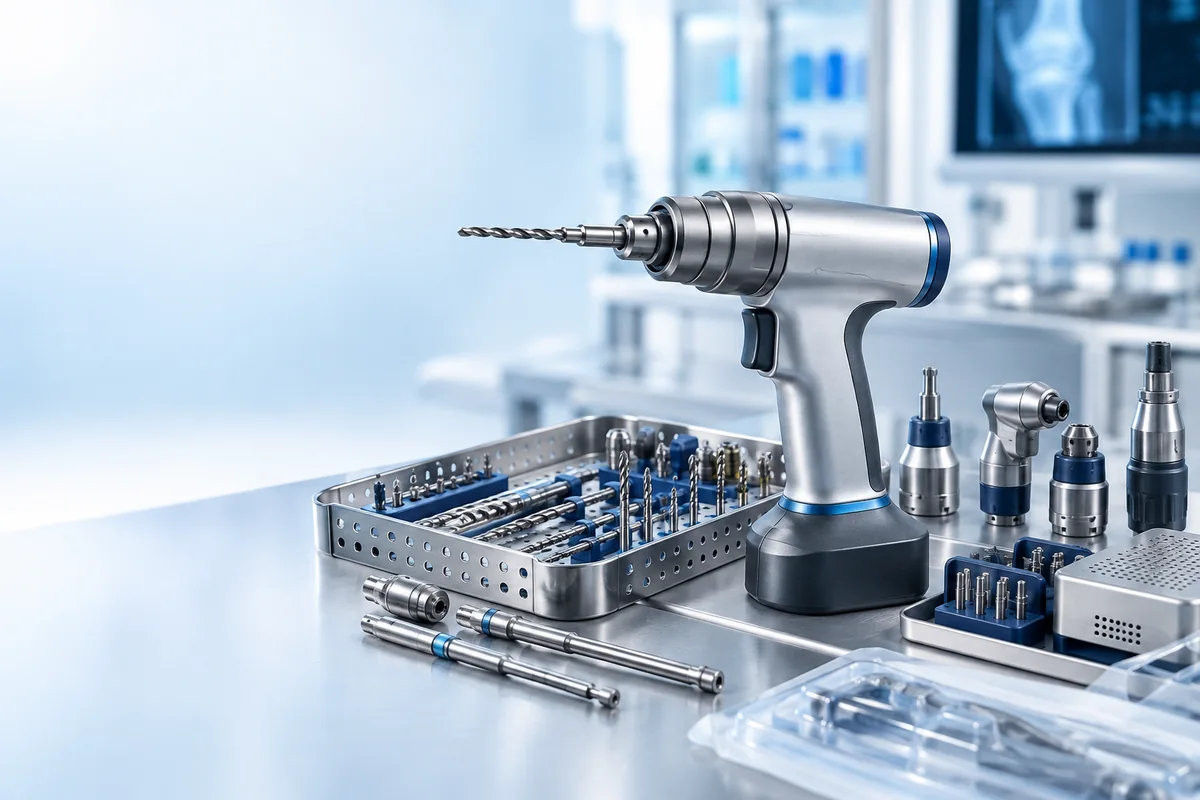
Powered bone instruments are usually evaluated as a system rather than as a handpiece alone. The instrument, drive interface, attachments, cutting accessories and supporting components must work together within the documented product configuration. For professional buyers, a systematic review makes it easier to compare options and identify questions before sample evaluation or purchasing.
Define the intended instrument category
Begin by confirming the procedure category and the type of powered instrument required. Bone drills, skull drills and their accessories can differ in structure, attachment interface and intended application. Product names are not enough to establish compatibility, so the exact model and component relationship should be documented.
Evaluate the complete instrument system
Handpiece and operating design
Review the handpiece dimensions, weight, grip form, control arrangement and connection method. These characteristics influence handling and should be assessed through the relevant product documentation and, where appropriate, sample evaluation.
Attachments and interfaces
Confirm which attachments are included and which are optional. Interface compatibility is critical: an attachment that looks similar may not be designed for the same handpiece or operating system. Buyers should use model numbers and supplier documentation instead of visual assumptions.
Drill bits and related accessories
Accessory selection may involve dimensions, geometry, material, connection interface and packaging. Create a clear accessory list for each target configuration, especially when multiple instrument models are being sourced.
Cleaning, processing and product documentation
Reprocessing, maintenance and storage requirements depend on the specific product. Buyers should request the applicable instructions and confirm whether individual components are reusable, single-use or subject to other documented limitations. These points should never be assumed from the material or appearance of a component.
Destination-market documentation, labeling and packaging requirements should also be discussed at the quotation stage. Early alignment helps avoid changes after samples or production planning.
A buyer’s comparison checklist
- Confirm the exact instrument model and intended product category.
- List all required handpieces, attachments and accessories.
- Verify interface compatibility using written documentation.
- Review packaging, labeling and destination-market requirements.
- Ask about samples and the evaluation process.
- Discuss replacement accessories and future supply requirements.
- Record any OEM or configuration requests before order confirmation.
Think beyond the first order
Long-term procurement planning should consider the availability of compatible accessories and the consistency of the selected configuration. Maintaining a model-based component list can make repeat orders clearer for both buyer and supplier.
Baiying Medical’s surgical instrument portfolio includes powered bone and skull drill products with related accessories. We support standard product enquiries as well as discussions around configuration and cooperation requirements.
Talk with the Baiying Medical team
To request product information, provide the target instrument category, model or reference specification, required accessories, quantity and destination market. Browse all products or email 1812861293@qq.com.
This article is for general product and procurement information. It does not provide clinical instructions and does not replace product documentation, professional judgment or applicable regulatory requirements.